

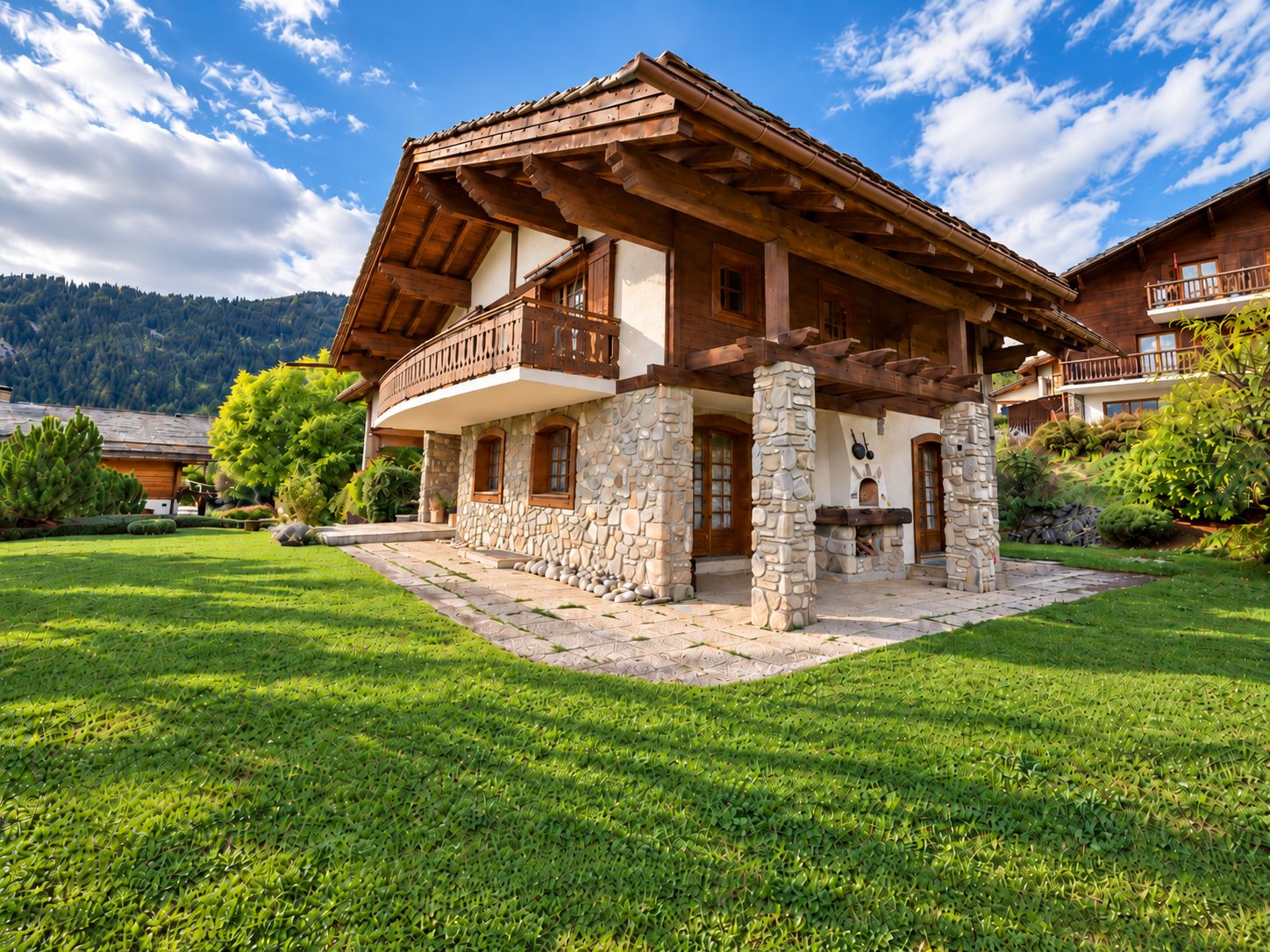
To value a property in Verbier, you need to determine its market value, meaning the price an informed buyer would be willing to pay in the current market, by combining an analysis of comparable transactions, the property’s real condition, its precise location and its legal status. In a resort where every chalet and every apartment has its own particularities, an average price per square metre or an automated tool is not enough. This guide explains the different notions of value, the methods used by experts, the criteria specific to Verbier, how a valuation works and the most common mistakes.
The key takeaway: a reliable valuation in Verbier rests on three pillars: local market data, an on-site visit and the signature of a qualified expert. Our property valuation service in Verbier is built around these three elements.
Why valuing a property is more delicate in Verbier than elsewhere in Switzerland
Valuing an apartment in a lowland city relies on a large number of comparable sales, with homogeneous neighbourhoods and widely published prices. In Verbier, the situation is different in several respects.
First, this is a market of micro-locations. Two chalets a few hundred metres apart can have very different values, depending on their exposure, the unobstructed view of the Combins and Mont Blanc, their proximity to the lifts, winter access or the level of peace and quiet. Two apartments in the same building are not worth the same either, depending on the floor, the orientation or the presence of a balcony.
Second, many properties are negotiated on a “price on request” basis. The prices actually agreed are therefore not displayed publicly, and asking prices do not always reflect selling prices. There is little reliable public data at resort level.
Third, the legal framework has a direct impact on value. The Lex Weber caps the share of second homes in tourist municipalities, which limits the construction of new homes of this type and supports the value of existing properties. The Lex Koller regulates acquisitions by people resident abroad. The exact status of a property (main residence, second home, tourist accommodation) determines resale rights and therefore the pool of potential buyers. To understand this framework, our guide to investing in Swiss real estate sets out the principles.
Finally, the new Valais construction law changes the renovation and extension prospects for some owners. We cover this in our article on the new Valais construction law and what it means in Verbier.

Market value, tax value, insurance value: which value are we talking about?
Before any valuation, the question being asked needs to be clear. A single property in fact has several values, which meet different needs and have no reason to be identical.
Market value
This is the value on the market: the most probable price at which the property would sell between a properly informed seller and buyer under normal conditions. It is the value sought when preparing a sale, a purchase, an inheritance settlement, a divorce or a financing application. It is also the value addressed by our property valuation in Verbier page.
Tax value
It is set by the cantonal authorities for tax purposes (notably wealth tax). It follows rules specific to each canton and often differs from market value, particularly in resorts where market prices are high. Tax value should therefore never be used as a basis for setting a selling price.
Insurance value
It corresponds to the cost of rebuilding the building. The land is not included, nor is the view, nor the rarity of the location, which nonetheless weigh heavily in the price in Verbier. A high insurance value does not mean a high market value, and vice versa.
The value used by banks
When a buyer finances an acquisition, the bank determines its own lending value, generally cautious, on which it calculates the amount it is willing to lend. It may rely on an external valuation. A valuation signed by a recognised expert makes dialogue with the lending institution easier.
In summary: before requesting a valuation, specify what it will be used for. A sale, an inheritance, a division between heirs or a financing file do not call for exactly the same report.
The valuation methods used by professionals
In Switzerland, experts combine several approaches. The choice and weight of each depend on the type of property and the purpose of the valuation.
The comparative method
It consists of comparing the property with similar properties sold recently in the same area, then adjusting the value according to the differences (surface area, floor, view, condition, features). It is the most relevant for an apartment in condominium ownership or for a chalet in an area where comparable transactions exist. In Verbier, its quality depends entirely on access to sales that have actually been completed, which only players active on the ground can document. This is one of the main assets of an agency established locally for more than 40 years.
The income method
It suits properties that are rented or could be rented. The value is calculated from the net income the property generates or could generate, capitalised at a rate suited to the market. For a chalet let by the season, the exercise calls for caution: realistic potential must be distinguished from theoretical potential, and the permits required for tourist lettings must be taken into account.
Intrinsic value, or replacement value
This approach adds the value of the land and the cost of rebuilding the building, reduced by depreciation linked to age and condition. It is useful for unusual or recent properties for which there are no comparables, for example an architect-designed property or a very large chalet.
Combined approaches
In Swiss practice, experts often weight several values to reach a reasoned market value. An expert’s report must always set out the method used and justify the adjustments, so that it can be read and understood by a bank, a notary or a court.
The online valuation tool
Automated tools work from statistical models. They give a first indication, useful for getting your bearings, but they see neither the view, nor the quality of the finishes, nor the condominium, nor the real condition of the property. In a market of micro-locations like Verbier, the gap between an algorithm’s result and the real value can be significant, in either direction.

The criteria that really make a property’s value vary in Verbier
These are the elements examined first during a valuation visit.
Location and exposure
A due-south orientation, a panoramic view, direct or quick access to the slopes, distance from the centre of the resort, peace and quiet and winter accessibility are among the main drivers of value. Each area of the Val de Bagnes has its own clientele and its own price references, across Verbier, Médières, Le Châble and the surrounding hamlets.
Type of property and legal status
A detached chalet, an apartment in condominium ownership, a duplex, a penthouse or a building plot are not valued in the same way. The status of the property (main or second home, tourist apartment) and the restrictions attached to it directly influence potential buyers. Our article on second home or primary residence in Verbier sheds light on this point.
Surface area, volumes and how they are calculated
Living area, usable area, annexes (cellar, garage, parking space, attic) and ceiling height are not always counted in the same way depending on the documents. A serious valuation checks surface areas against the plans and the land register, and does not rely solely on the details of an old listing.
Condition, materials and renovations
The quality of construction, the year and extent of the latest renovations, and the condition of the roof, façades, heating and technical installations all weigh on value. Well-documented works, with invoices and permits, reassure the buyer and are reflected in the price. Works carried out without a permit, on the other hand, can become an obstacle to the sale.
Sought-after features
A wellness area, a fireplace, a wine cellar, a garage, a lift, a ski room or a large terrace are among the features that set a property apart for this demanding clientele. Their impact depends, however, on their quality and on how well they fit with the property as a whole.
Condominium and charges
For an apartment, the condominium regulations, the level of charges, the state of the renovation fund, the decisions taken or upcoming at general meetings and the quality of the building’s maintenance all influence value. A building where major works are still to be funded is not worth the same as a recently renovated one.
Easements and constraints
Rights of way, view rights, building restrictions, zoning plans, natural hazards: these elements appear in the land register and in municipal planning documents. They can strengthen or reduce a property’s potential.
Market context
Interest rates, financing conditions, international demand and available supply all change. To place these trends, our analyses of Swiss property prices in 2026 and their effect in Verbier provide a general overview, which an individual valuation then refines.
Can a property in Verbier be valued using a price per square metre?
The question comes up often, and the answer needs nuance. A price per square metre gives an order of magnitude, but in Verbier it can be misleading. It varies greatly with the area, the type of property, its age, the view and the level of finish. It does not distinguish a due-south apartment with a balcony from a ground-floor apartment in the same building. It poorly reflects the value of land, which weighs far more in a detached chalet than in an apartment.
Use the price per square metre as a benchmark, never as a value. It must be completed by precise comparable transactions, which you can obtain during a personalised valuation.
Online valuation or on-site expertise: which to choose?
The two approaches do not meet the same need. An automated valuation may suit first-time curiosity, with no financial stakes. As soon as you are preparing a sale, a division of assets, a tax matter or a financing application, on-site expertise becomes necessary, for four reasons.
First, the expert sees the property: they note its real condition, the view, the finishes and the volumes. Second, they know the sales completed in the area, including those that were never advertised. They also check the legal documents, which can change the value. Finally, they produce a reasoned report, which explains the method and which other professionals can review.
Why use an expert with a Swiss federal diploma?
At Schraner Luxury Realty, valuations are carried out by Malko Schraner, a real estate valuation expert holding the Swiss federal diploma (brevet fédéral). It is a protected title, obtained after a federal professional examination, and the diploma is issued by the State Secretariat for Education, Research and Innovation (SERI). This title attests to recognised skills in valuation methods, property law and market analysis.
In practical terms, this qualification makes it possible to provide a market value valuation for inheritance, division of assets, divorce, tax disputes or financing, signed and recognised by a bank, a notary or a court. This is the essential difference from a simple price range: the report is reasoned, signed by its author and can be produced as evidence in proceedings.
This expertise draws on more than 40 years of local presence. Our knowledge of neighbourhoods, buildings, condominiums and real transactions feeds every analysis.
How a valuation works at Schraner Luxury Realty
The process is deliberately simple and takes place in five steps.
- The request. You contact us by email (info@schraner-verbier.ch), or you call us (+4127 771 60 70) or write to us on WhatsApp (+41768424287).
- The first conversation. Our expert contacts you to understand your project: a sale, an inheritance, financing or simply knowing the value.
- The visit. Malko come to the property, visit it, note its characteristics and check the documents. Your presence is strongly recommended, as you know best about the renovations, the features and the particularities of the property.
- The analysis. He compares the property with transactions on the local market and choose the appropriate method or methods.
- The report. You receive your personalised valuation, together with strategic advice on selling or buying.
Your information remains confidential at every stage. The valuation service does not commit you to anything: you can simply find out the value of your property, with no immediate plan to sell.
The documents to prepare before the visit
Gathering the right documents speeds up the analysis and improves the accuracy of the result. Depending on the nature of the property, these may include:
- a recent land register extract, showing any easements and notes;
- the plans, surface areas and description of the property;
- for an apartment, the condominium regulations, the minutes of the latest meetings, the annual statement of charges and the state of the renovation fund;
- invoices and permits for renovation or conversion works;
- any available technical certificates or reports (energy, installations, assessment of the roof or façades);
- rental agreements, if the property is let, or the history of seasonal lettings;
- a few recent photographs of the different rooms and the outdoor areas.
Missing a document? This does not block the process: our team will tell you what can be obtained from the land register, the municipality or the managing agent.
The most common mistakes when valuing a property
Certain mistakes come up regularly. Knowing them helps you avoid them.
- Relying on a neighbour’s asking price. An asking price is not a selling price. A property advertised for a long time without a buyer even gives the opposite indication.
- Overvaluing out of attachment. Memories and the work carried out weigh on our judgement, whereas a buyer will not pay what the property represents to you, but what it is worth on the market.
- Comparing with Swiss averages. A national average price has no relevance for a chalet in Verbier. The scarcity mechanisms at work there are specific to the Alpine market.
- Ignoring the legal status. A property subject to restrictions does not sell at the same price, nor to the same audience.
- Forgetting to document the works. Renovations without invoices or permits carry little weight.
- Requesting a valuation without a visit. It gives an indication, never a reasoned value.
- Multiplying valuations without comparing them. Obtaining several opinions can be useful, provided you understand which method and which value each is based on.
From valuation to sale: what happens next
A valuation is not an obligation to sell. It can simply be used to know the value of your assets, to prepare an inheritance or to discuss matters with your bank. If you decide to sell, the market value becomes the basis of the strategy: setting a coherent asking price, preparing the property, presenting it to qualified buyers, negotiating and then providing support through to signing at the notary.
An initial price that is too high lengthens the timeline and weakens the negotiation. A price that is too low loses part of the value. The valuation is there precisely to establish this fair price. To understand the rest of the process, discover our page on how to sell a property in Verbier. And if your project is rather a purchase, our page on buying in Verbier presents the available properties.
FAQ: valuing a property in Verbier
How do you value a property in Verbier?
You combine the analysis of comparable transactions in the same area, a visit to the property, the checking of legal documents and, depending on the case, an income approach or a replacement value approach. The result is presented in a reasoned report, ideally signed by a qualified expert.
What is the difference between market value and tax value?
Market value is the probable market price of the property. Tax value is set by the canton for tax purposes, according to its own rules, and often differs from market value. Only market value is used to prepare a sale.
Can a valuation be used for an inheritance or a divorce?
Yes, provided it is structured, documented and signed by a qualified expert. A market value valuation report signed by an expert with a Swiss federal diploma can be presented to a bank, a notary or a court. An online tool does not produce a document of this kind.
Do I need to be present during the valuation visit?
Your presence is strongly recommended. You are best placed to tell us about recent renovations, features, easements or particularities of the property, all of which can significantly influence the final value.
Conclusion
Valuing a property in Verbier takes more than a calculation: you need to choose the right value, the right method, reliable comparables and a detailed knowledge of the ground and the legal framework. A valuation carried out on site by an expert with a Swiss federal diploma, backed by more than 40 years of local presence, gives you a solid basis for deciding, whether your project is a sale, a division of assets, financing or simply a better understanding of your assets.
Have your Verbier property valued
Fill in the form in a few minutes or contact us directly. Your personalised valuation, carried out by an expert with a Swiss federal diploma, is delivered within 14 days. Your information remains confidential.


